
Revenue Motion Framework™ Glossary
Canonical definitions of the vocabulary used in the Revenue Motion Framework™ — the terms, roles, and operating concepts that make the framework work in practice.
The Revenue Motion Framework™ introduces vocabulary that doesn’t exist elsewhere in the B2B demand generation literature at the same specificity. This glossary is the canonical source for those terms — used in the framework, the ebook, and in every article, post, and podcast that references the methodology. Each entry defines the term, explains what problem it solves, and links to the operating context where it lives.
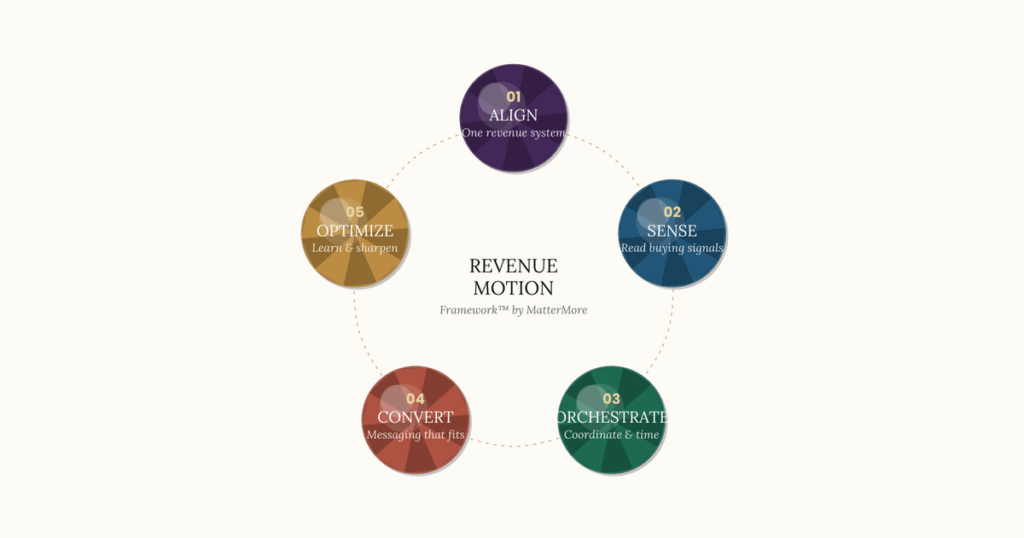
Framework terms
Account Interest Rating (AIR) — A 0–100 score per account that combines intent signals, first-party behaviour and role-level engagement into one actionable number. The operational heart of Phase 2 (Sense). Read more →
Marketing Account Developer (MAD) — The marketing role that develops AIR-flagged target accounts into Qualified Opportunities, without contacting the buyer, before the Business Developer takes over. Read more →
Business Developer (BDR) — The role that picks up Qualified Opportunities from the MAD, reaches out to the buying group and builds the qualification, so the Account Manager can accept it as a sales opportunity.
Four-stage operating model — The account progression that structures Phase 3 (Orchestrate): Target → Spotted → Qualified → Accepted, with written transition criteria that marketing and sales share. Read more →
Opportunities spotted by marketing — The framework’s replacement for leads: accounts where signals show a real buying process, worked as one opportunity across the buying group. Sales picks them up faster than leads because they arrive with context.
Qualification packet — The summary the MAD hands to the BDR: the signal pattern, the buying-group map, which content each role engaged with, and a recommended entry point.
Cost per opportunity (account level) — The efficiency measure the framework uses instead of cost per lead: spend divided by the number of qualified opportunities, counted per account rather than per contact.
Persona × maturity matrix — The Phase 4 (Convert) messaging framework that pairs each buying-group role with the organisation’s maturity level, from A (Standardising) to E (Innovating), so every message matches where the buyer actually stands.
Weekly operating meeting — The weekly meeting of 30 to 45 minutes between a senior marketing leader and a senior sales leader, both empowered to decide, where leading indicators are reviewed and at least one button is moved. The core of Phase 5 (Optimize).
The buttons — The named set of levers the weekly operating meeting can adjust: audience targeting, content topics, paid media allocation, account priority and messaging angle per maturity level.
Dark funnel — The research buyers do outside your visibility: peer conversations, communities, analyst reports and, increasingly, AI assistants. The framework treats it as a signal and coordination problem, not a lead problem.
AI-era terms
Answer engine — An AI assistant, such as ChatGPT, Perplexity, Claude or Google’s AI answers, that reads many sources and gives the buyer one answer instead of a list of links.
Generative engine optimisation (GEO) — The discipline of making your point of view the answer AI assistants cite when buyers ask about your category. Related to SEO, but aimed at being cited in a synthesised answer rather than ranked in a list of links.
AI citation share — How often AI answers name or cite you on a fixed set of buyer questions, compared with competitors. An early indicator of whether you are on the buyer’s shortlist.
Self-reported attribution — Asking new opportunities directly where they first heard of you. It captures the routes that click-based attribution misses, such as AI answers, peers and podcasts.
Buying group — The group of stakeholders, often ten or more across IT, finance, procurement, security and the business, who decide together on an enterprise purchase.
Intent data — Third-party signals about what companies research across the web. One input to the Account Interest Rating, never a trigger for sales on its own.