
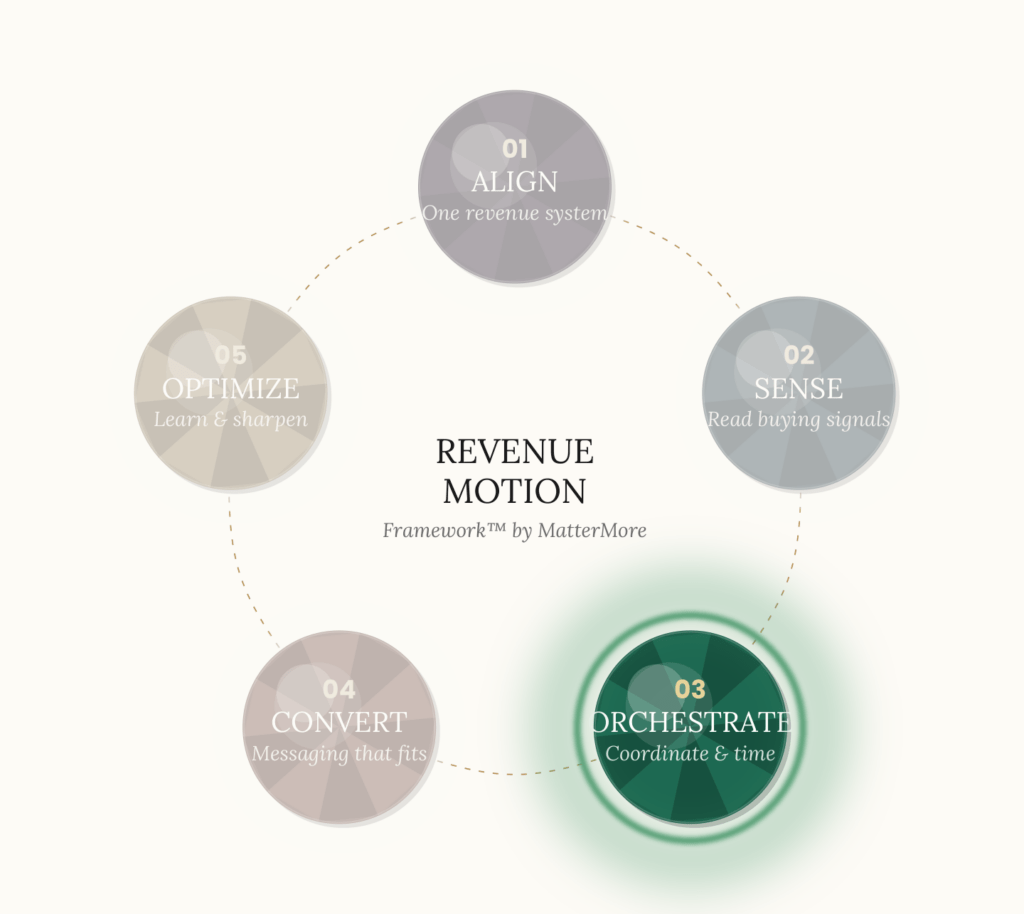
Orchestrate — Phase 3 of the Revenue Motion Framework™
From buying signal to one coordinated play across marketing and sales
When a buying signal fires, the buyer should experience one coherent conversation across channels — not twelve disconnected touches.
What you get
A play library that maps buying signals to coordinated, multi-channel motions, with clear ownership at every step.
The problem this phase solves
Why one signal becomes twelve touches
A target account starts comparing your product on G2 and visiting your pricing page. The Account Interest Rating spikes (see Phase 2 — Sense). Then five things happen in the same 72 hours, none of them aware of each other:
- Marketing automation drops the account into a nurture sequence triggered off the pricing visit.
- Paid retargeting starts serving banner ads to every cookie at that domain.
- The SDR working the territory pulls the account into a 14-touch outbound cadence.
- The Account Manager fires off a “saw you were looking — happy to chat” LinkedIn message.
- An exec at the selling company, alerted by an internal dashboard, sends a peer-to-peer note to their counterpart.
The buyer experiences this as twelve disconnected touches from one vendor in one week. They pattern-match to “we’ve been targeted” and either disengage or — worse — quietly route the evaluation around you. The signal was real. The orchestration failed.
Orchestrate is the phase that turns a spike into one coherent conversation, sequenced across channels and roles, with explicit handoffs between functions. Without it, every prior investment — alignment, signal infrastructure, account scoring — leaks at the moment of action.
What "good" looks like
What Orchestrate actually produces
Orchestrate produces four artefacts. None of them are tooling decisions; they are operating-model decisions that the tooling then executes.
- A four-stage account model with explicit transition criteria.
Every account in the universe sits in exactly one of four marketing-owned stages:- Target Account — in the ICP, on the list, no qualifying intent yet.
- Spotted Opportunity — the Account Interest Rating has crossed the threshold or other intent signals have fired. Worth investigating, not yet worth interrupting sales for.
- Qualified Opportunity — the Marketing Account Developer has actively developed the account and confirmed three things: fit (still inside ICP after a closer look), buying-group activity (multiple roles engaged, not a single curious user), and credible timing (the evaluation appears to be real and current).
- Accepted Opportunity — sales has reviewed the qualification packet, taken ownership, and committed the account into pipeline.
Each transition has written criteria. Spotted is not an opinion. Qualified is not “we like this one.” The criteria are agreed in Phase 1 (Align) and operationalised here.
- A Marketing Account Developer role + queue.
A named role — distinct from BDR/SDR and distinct from marketing campaign managers — whose job is to work Spotted Opportunities into Qualified Opportunities. They run the development plays (Section 3 below), document what they learn on each account, and prepare the qualification packet that hands over to sales. Without this role, intent signals sit in a dashboard nobody develops, and “alignment” defaults to whoever shouts loudest. - A play library + role-by-role messaging matrix.
For each recognisable spike pattern (e.g.- pricing + competitor comparison,
- technical-evaluation cluster,
- renewal-window expansion signal),
one defined play. Each play has a name, a trigger, a set of moves, an owner per move (almost always the MAD before Qualified, sales after Accepted), an exit condition, and a per-role messaging angle. The CFO, the VP Engineering, and the practitioner don’t get the same opening line — the matrix is where that discipline lives. Six to twelve plays cover the vast majority of patterns.
- A handoff + acceptance protocol — with a return-with-comments path.
When the MAD marks an account Qualified, sales has a written SLA (e.g. 48 hours) to review the packet and respond in one of two ways: Accept (stage transitions to Accepted Opportunity, sales takes ownership of pipeline and reporting, marketing automation suspends), or Return with comments (stage drops back to Spotted with written feedback attached — “wrong product fit, looks like a hybrid-cloud play” — and the MAD either acts on the feedback or formally de-qualifies). The handoff is not triggered by an intent score. The intent score is an insight for sales (context, not a task) and a signal for the MAD (a queue item, not a hand-raise). Qualified-to-Accepted is the only stage transition sales touches.
If these four artefacts don’t exist, you don’t have orchestration. You have busy departments.
Three roles, not two.
The Revenue Motion Framework™ distinguishes three operational roles across the marketing-to-sales handoff: the
1 – Marketing Account Developer (MAD) owns Spotted → Qualified, the
2 – Business Developer (BDR) owns the Qualified → Accepted approval gate, and the
3 – Account Manager (AM) owns Accepted → Won.
Collapsing any two of these into one role is the most common reason the operating model breaks in practice.
Sub-capabilities
The five capabilities that make Orchestrate work
Capability 1 — Stage discipline.
Moving accounts cleanly through Target → Spotted → Qualified → Accepted requires written transition criteria and a single source of truth. Without written criteria, Qualified drifts to mean “marketing wants this to be a deal” and sales (correctly) ignores it. Stage discipline is the unglamorous foundation everything else rests on.
Capability 2 — The weekly joint rhythm.
A well-running orchestration system has a weekly rhythm that keeps marketing and sales operating from the same picture. At the start of each week, account intelligence is reviewed jointly — which accounts have increased in signal strength, which have plateaued, which new accounts have entered the target tier, which Spotted Opportunities are progressing toward Qualified, which Qualified packets are awaiting BDR review. This is where the joint gate-keeping decision lives: before the MAD is activated on a new Spotted Opportunity, both functions agree that the account is worth developing. Sales brings essential context — existing relationships at the account, open opportunities that might create conflict, capacity constraints. Activating the MAD on an account that sales cannot or will not eventually accept is wasted effort — and erodes the trust between the two functions that the entire system depends on.
Capability 3 — Account development.
The work the Marketing Account Developer does between Spotted and Qualified. Multi-touch, multi-role outreach designed to confirm fit, map the buying group on this specific account, validate the timing of the evaluation, and document what was learned. This is the hardest capability to build because it requires marketing people who can think like sellers without being sellers — and who can comfortably mark an account de-qualified when the development work tells them it isn’t real.
Capability 4 — Play design and choreography.
A play is a repeatable answer to a recognisable spike pattern. Designing one means: identifying the pattern (which signals, which threshold, which roles active), sequencing the moves (which touches in what order across channels), assigning the owner of each move, building the per-role messaging matrix so the CFO and the VP Engineering each hear the right angle, and setting an exit condition (Qualified, de-qualified, explicit “not now,” or hard timeout). The choreography — three well-timed touches over 14 days, not twelve in five — is what makes a multi-role motion feel like one conversation rather than vendor harassment.
Capability 5 — Handoff and feedback discipline.
Most “alignment” work breaks at the qualified-to-accepted handoff. The MAD believes the account is ready; sales finds five reasons it isn’t. Without a protocol, the handoff becomes politics. With one, it becomes a contract: marketing produces a qualification packet, sales has an SLA to Accept or Return-with-comments, returned accounts go back to the MAD’s queue with the written feedback attached. Sales owns opportunity reporting after Accept. Success rate from Qualified → Accepted → Won is a recurring joint conversation between marketing and sales — not a marketing slide, not a sales report.
A short example
What this looked like in practice
A B2B SaaS team had alignment (Phase 1) and a working AIR with a unified dashboard (Phase 2). When an account hit AIR 70+, it surfaced as “spiking” — visible to both sales and the Marketing Account Developer. What happened next was undefined. Sometimes the MAD developed it, sometimes an AM called it directly, sometimes marketing dropped it into a nurture, sometimes nothing happened at all. Of the accounts that crossed into the spiking band in Q1, 71% never received any coordinated development work. The signal infrastructure was doing its job. Orchestration wasn’t there to catch what it produced.
We rebuilt the operating model around the four stages and one play. Walk a single account through it: TechCo
Day 0: Target → Spotted.
TechCo is a named Target Account on the AM’s list. The AIR has been background-level for months. Today it spikes to 78 — driven by pricing-page repeat visits and competitor comparison reads from the VP Engineering (3 sessions) and CFO (2 sessions) over the last 6 days. The unified dashboard shows the new status — Spotted Opportunity — to both the AM (as insight: “your account is heating up; marketing is developing it”) and the MAD (as a queue item: “develop this one this week”). The ABM ads layer for TechCo activates with two creative variants: procurement-angle to CFO/Procurement personas, technical-fit-angle to Engineering personas. No sales outreach yet. Sales sees the spike; sales does not act on the spike.
Day 1–10: MAD runs the development play.
The Pricing + Competitor Comparison development play kicks in, owned end-to-end by the MAD:
- Day 1 — MAD sends a personalised LinkedIn message to the CFO, drafted from the messaging matrix (procurement-fit angle). Not “saw you on our pricing page” — a peer-style opener about how teams typically frame the buy-vs-build comparison.
- Day 4 — MAD sends an email to the VP Engineering with a 90-second technical demo loom link, anchored to the specific integration concerns the named competitor typically misses.
- Day 7 — If neither has replied, the MAD coordinates a peer-to-peer LinkedIn note from the selling-company CTO to the CFO’s counterpart. No pitch — a peer note about evaluating the category.
- Day 10 — MAD sends a tailored case study email to the CFO matched to the named competitor in the evaluation set.
Throughout, the MAD is documenting in the account record: which roles replied, what they said, what the AIR did each day, what the ad-layer engagement looks like. The goal of the development play is *not* to book a meeting. The goal is to *confirm three things*: fit, buying-group activity, and credible timing.
Day 11: Spotted → Qualified.
The MAD’s notes show: TechCo is still firmly in ICP (fit ✓), VP Engineering replied positively and forwarded to a Director of Platform (buying-group activity ✓), the CFO mentioned a Q3 budget cycle (credible timing ✓). The MAD marks the account Qualified Opportunity and generates the qualification packet — a one-page summary with: the spike pattern that triggered development, what was learned about the buying group, what was said by whom, the suspected procurement window, and a recommended first conversation angle for sales. The packet surfaces to the AM with a 48-hour SLA.
Day 12: AM reviews.
The AM has two paths.
- Accept — the packet checks out, the AM agrees the timing and fit are real, stage transitions to Accepted Opportunity, sales takes ownership of the relationship and the pipeline reporting from this point, marketing’s automation suspends for this account, and the AM books the first conversation.
- Return with comments — the AM writes back: “Wrong product fit — this looks like a hybrid-cloud play, we’re an on-prem story; or the buyer they’re talking to has no authority and we’ve seen this pattern stall three times before.” Status drops to Spotted with the comments attached. The MAD either acts on the feedback (re-develop with the corrected angle), waits for a fresh signal, or formally de-qualifies the account. In TechCo’s case, the AM accepts.
Day 14+: Sales leads.
TechCo is now an Accepted Opportunity. Sales runs the validation play (a post-acceptance play, different from the development play), owns the opportunity reporting, and pulls in marketing for tailored assets on request. The unified dashboard still shows TechCo’s stage, the AIR trend, and the active roles — but the action layer for this account has moved from the MAD’s queue to the AM’s pipeline.
The result.
Across two quarters, the operating model produced four shifts that mattered. The Spotted-to-Qualified rate (development work resulting in genuinely-qualified accounts within 21 days) moved from informal-and-unmeasured to a steady 60–70%. The Qualified-to-Accepted rate (sales actually taking the handoff) moved to roughly 75%, with the rejected 25% giving the MAD specific, actionable feedback rather than silent ignoring. Win rate on Accepted Opportunities ran materially above win rate on cold-outbound deals — the qualification work was filtering for real evaluations, not just curious users. And the recurring conversation between marketing and sales — held monthly, looking at Spotted → Qualified → Accepted → Won as one funnel rather than two silos — became the place where qualification criteria, play design, and messaging matrix all got recalibrated based on what actually closed.
Three things to notice. First: the AIR is not a hand-raise to sales. It’s a signal to the MAD and an insight to sales. The handoff is the moment the Qualified packet is reviewed, not the moment the score crosses a threshold. Second: the return-with-comments path is what makes alignment real. If sales can’t push back without consequence, qualification quality erodes. Third: success rate is a joint conversation, not a marketing report. Sales owns opportunity reporting; both teams jointly own the question of whether the qualification engine is producing accounts that close.
Where to go from here
Once Orchestrate is working
A working Orchestrate capability is what makes Phase 4 (Convert) possible. Conversion is downstream of well-timed, well-sequenced, well-handed-off motions — not better closing technique.
Three ways to take this further:
- Read the full chapter — Phase 3 is covered in depth in the Revenue Motion Framework™ ebook, including the play-design template and the role-messaging matrix worked example. Buy the ebook (€79 ex VAT) →
- Implement it — the Implementation Toolkit adds the 90-Day Action Plan deck, so you can audit your current signal stack and rebuild it as a structured sprint. Get the Toolkit (€149 ex VAT) →
- Work through it together — book a Strategic Review and we’ll audit your signal stack in a focused session. Request a Strategic Review →
Previous phase: ← Phase 2 — Sense. Next phase: Phase 4 — Convert →
FAQ
No. The AIR is an *insight* for sales (context on what’s heating up upstream) and a *signal* for the Marketing Account Developer (a queue item to develop). Sales acts when an account becomes *Accepted Opportunity* — after the MAD has done the qualification work and the AM has reviewed and approved the packet. Skipping the qualification stage and sending raw intent spikes straight to sales is the single most common reason “intent data” gets ignored.
They work *Spotted Opportunities* into *Qualified Opportunities*. That means running the development play (multi-touch, multi-role outreach with the explicit goal of confirming fit, mapping the buying group on this specific account, and validating timing), documenting what they learn, and producing the qualification packet that hands to sales. It’s a marketing role with a sales mindset — comfortable with outreach but not measured on booked meetings. Measured on Spotted-to-Qualified conversion rate and on what Accepted Opportunities later win.
Six to twelve covers most B2B SaaS environments. Most of those will be development plays (Spotted → Qualified). A smaller number are validation/expansion plays for Accepted Opportunities. More than fifteen becomes unmaintainable — nobody remembers which applies when, so people improvise, which is what you were trying to escape from.
The account drops back to *Spotted* with the comments attached to the record. The MAD has three choices: act on the feedback (re-develop the account with the corrected angle), wait for a fresh signal before re-engaging, or formally de-qualify the account. The point of return-with-comments is to make pushback safe and *useful* — sales gets to reject without politics, marketing gets actionable feedback, and the next account that hits the same pattern gets developed better.
Sales owns opportunity reporting once an account is *Accepted* — pipeline, forecast, win/loss. The success-rate question — what fraction of *Qualified* opportunities become *Accepted*, and what fraction of *Accepted* opportunities become *Won* — is a recurring joint conversation between marketing and sales, typically monthly. That conversation is where the qualification criteria, the play library, and the messaging matrix get recalibrated. If success rate isn’t being reviewed jointly, the operating model has reverted to two silos.