
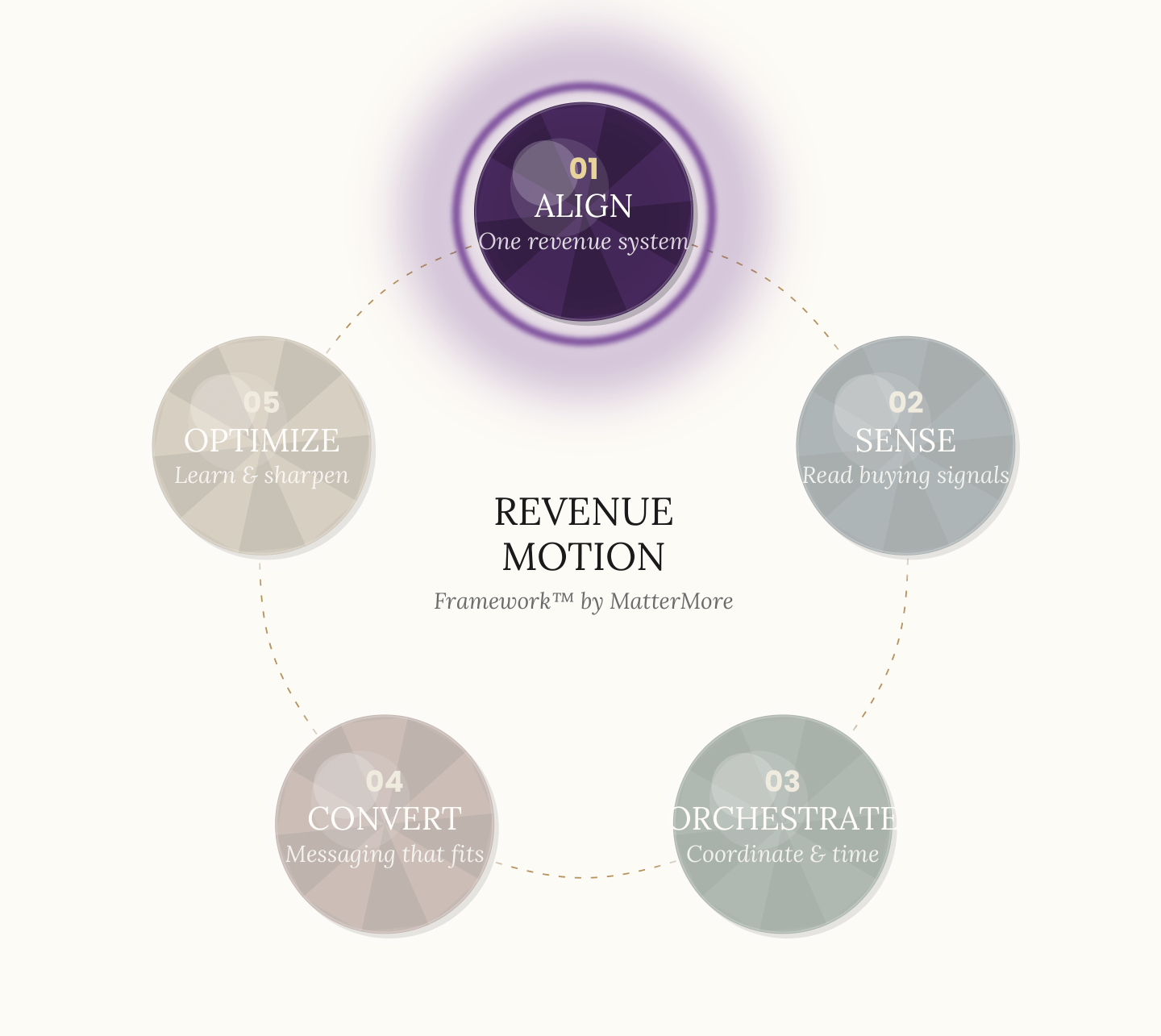
Align — Phase 1 of the Revenue Motion Framework™
Marketing and sales alignment: how to make it stick
Most B2B revenue teams skip this phase because it feels obvious. It’s why everything downstream fails.
What you get
A single, written agreement across marketing, sales and customer success on who you sell to, what counts as in-market, and what you stop doing.
The problem this phase solves
The alignment trap
Most misalignment doesn’t look like conflict. It looks like coordination. Marketing runs campaigns. Sales follows up. There are handoff processes, SLA agreements, lead scoring models. On paper, the system works. In practice, sales quietly stops trusting marketing leads and builds its own pipeline. Marketing keeps optimising for volume because that’s what gets reported.
The buyer experiences this too. What they experience is inconsistency. The ad says one thing. The sales conversation goes in a different direction. The follow-up email feels disconnected from the content the buyer just read. In enterprise buying, where trust is everything and deals take months, that disconnection has a cost that never shows up in a campaign report.
The problem is not communication. It is ownership. Marketing owns MQLs. Sales owns revenue. And in that gap — between the metric marketing is measured on and the outcome the business actually needs — enormous amounts of effort, budget, and opportunity disappear. Talking is not the same as being accountable for the same outcome. Until that structural ownership question is fixed, every downstream phase is operating on a fault line.
What "good" looks like
What genuine alignment requires
Alignment is not a workshop, an offsite, or a new Slack channel. It is a structural change in how both teams operate — specifically in three areas. These are not artefacts you produce once. They are operating disciplines.
- Shared accounts.
A shared definition of who you are actually going after — not a vague ICP document that lives in a Google Drive folder no one opens. A live, specific, agreed list of accounts that marketing and sales selected together. The act of joint selection is the alignment. A list that one function built and the other inherited is not a shared list. The accounts on it are also the foundation for every downstream phase: they are the Target Accounts that Sense (Phase 2) watches and that Orchestrate (Phase 3) develops. - Shared language.
Marketing talks about impressions, MQLs, and content engagement. Sales talks about conversations, timelines, and stakeholder maps. Alignment means building a common vocabulary around pipeline stages, buying signals, and account momentum that both teams can read and act on together. The four operational stages — Target → Spotted → Qualified → Accepted → Won — used in Phases 2–4 only work if both teams share the same definition of each transition. The MAD, BDR, and AM roles (introduced in Phase 3) only work if their handoffs use the same language. - Shared accountability for pipeline.
Not marketing accountable for leads and sales accountable for revenue. Both teams accountable for the same number: qualified pipeline generated from target accounts. Shared targets, shared rewards, one number that both functions are evaluated against. This is the hardest structural shift to make and the one that everything else stands on. Without it, the other two shifts decay back into politics over months.
If your team has handoff processes, SLA agreements, and lead scoring models — but not these three shifts — you have coordination. Coordination is not alignment.
Sub-capabilities
The three capabilities that make Align stick
Capability 1 — Joint account selection.
The discipline of marketing and sales selecting the target account list together — not marketing proposing and sales approving, not sales building and marketing supporting. Selection is the act that turns “we agree on the ICP” into “we are working the same list.” Without joint selection, the target list becomes two parallel lists that disagree quietly. Joint selection is also what makes Phase 2’s signal data meaningful: signals on accounts that only one function cares about don’t trigger coordinated action.
Capability 2 — Common vocabulary, operationally.
Saying you have shared language is easy. Operationalising it is the work. Both teams need to use the same words for the same things: Target Account, Spotted Opportunity, Qualified Opportunity, Accepted Opportunity. Marketing reporting and sales reporting must roll up to the same scorecard. The qualification packet (Phase 3) only works if marketing and sales agree on what “qualified” means. Vocabulary discipline is unglamorous and is the thing that prevents three months of progress from quietly drifting back to silos.
Capability 3 — One number, shared.
The single most important structural change. Marketing and sales running on the same target — qualified pipeline generated from target accounts — tied to pre-defined goals. Account selection becomes a joint conversation. Messaging becomes something sales has a stake in. Marketing investment decisions get evaluated against pipeline impact, not campaign metrics. This is also what makes the Phase 5 weekly operating meeting possible: two leaders, one number, one system.
A short example
What this looked like in practice
When building the demand generation program at Unit4, the starting point looked familiar. Marketing and sales were talking — regularly, even productively. There was genuine goodwill between the teams. But ownership of the outcome sat in different places. Marketing was measured on lead volume and campaign performance. Sales was measured on revenue.
The shift that changed everything was structural, not cultural. Marketing and sales were given shared pipeline targets — a single number both teams were responsible for hitting. Suddenly, account selection became a joint conversation. Messaging became something sales had a stake in. Marketing investment decisions were evaluated against pipeline impact, not campaign metrics.
The result was a program that Forrester recognised as the EMEA ABM Award winner — and more concretely, a 10% increase in conversion rates across target accounts. Not because the campaigns became more sophisticated. Because the system behind them finally had two functions pulling in the same direction.
That improvement was not a one-off. It was the foundation that made everything in the framework downstream of Phase 1 actually work — the signal infrastructure, the Account Developer role, the joint account decisions, the weekly operating meeting. None of those mechanisms compound if the structural ownership question hasn’t been fixed first.
The three misalignment patterns to watch for
The three misalignment patterns
Once alignment has been built, three specific patterns will try to erode it. Naming them makes them easier to catch early.
Metric divergence — when marketing is optimising for a number that sales doesn’t care about. This is the original sin. If marketing’s KPI is MQLs and sales’ KPI is revenue, the misalignment is structural and only a shared scorecard fixes it.
Account divergence — when marketing is activating accounts that sales hasn’t prioritised and won’t follow up on. Spotted Opportunities surfacing on accounts the AM doesn’t recognise, signals firing on accounts that aren’t on the joint list. This pattern is what makes the Phase 3 “joint gate-keeping decision” so important: the BDR’s approval of a Qualified Opportunity is also a check that the account belongs on the list at all.
Narrative divergence — when what marketing says and what sales says tells different stories to the same buyer. The ad promises one outcome, the AM’s conversation pitches a different one, the case study sent the next day reinforces a third. The Phase 4 messaging matrix exists to prevent this — but only works if the matrix is jointly maintained.
These three patterns all have the same fix: bring them back to the weekly operating meeting in Phase 5 and re-anchor on the three structural shifts.
Where to go from here
Once Align is done
Phase 1 is the only phase you should not try to do alone. Get the CRO in the room. Make the three structural shifts the agenda for one focused week, not a six-month working group. Alignment is never finished — markets shift, priorities change, new sales leaders arrive with different instincts. High-performing revenue teams treat alignment as an ongoing practice, built into weekly rhythms, monthly reviews, and quarterly planning — not as a problem that was solved once and can now be assumed.
Three ways to take this further:
- Read the full chapter — Phase 1 is covered in depth in the Revenue Motion Framework™ ebook, including the four-artefact templates. Buy the ebook (€79 ex VAT) →
- Implement it — the Implementation Toolkit adds the 90-Day Action Plan deck and the framework one-pager, so you can run Phase 1 as a structured sprint. Get the Toolkit (€149 ex VAT) →
- Work through it together — book a Strategic Review and we’ll work through your alignment artefacts in a focused session. Request a Strategic Review →
Next phase: Phase 2 — Sense →
FAQ
No. ICP is a revenue exercise. If marketing owns it alone, sales will ignore it. The CRO (or the most senior revenue leader) must own the document. Marketing executes inside it.
Two to six weeks for a focused team. If it takes longer, the problem is decision-making authority, not analytical complexity. The answer is rarely “more data.
Yes. The ICP shifts. The buying group shifts. The signals shift. An annual recommit — same four artefacts, dated and signed by the revenue leadership — is the minimum.
You can. Most teams do. It’s also why most teams stall at Convert. Skipping Align doesn’t save time; it just delays the cost.
The stop-doing list. Without explicit subtraction, the revenue team will keep doing yesterday’s work alongside the new motion, and neither will get full attention.