How Enterprise Buying Actually Works
In enterprise B2B, buyers do not move as individuals. They move as buying groups — typically 10–20 stakeholders across IT, finance, procurement, security, and the line of business — and most of the buying journey happens invisibly, through peer conversations, AI search, anonymous research, and internal evaluations. By the time someone fills in a form, they are usually deep into their decision. The implication is structural: leads are the wrong unit of measurement, and signals — patterns of behaviour across an account — are what actually predict revenue.
Buying is a group decision
A deal is rarely driven by one person. It is a group effort: decision makers, influencers, technical evaluators, procurement, finance — each with different priorities, different questions, different risks. And most of the time, those people are not aligned with each other.
This means something critical: there is no single “lead” that represents a real opportunity. What you are actually trying to influence is a buying group in motion — a set of stakeholders moving (and stalling) at different speeds inside the same account.
If your reporting still treats each lead as an independent unit of demand, you are reporting on a fiction. The real unit is the account. The real signal is what the group is doing inside it.
The dark funnel
Most of the buying journey is invisible. Buyers:
- Talk to peers, in private channels you cannot see.
- Use AI chat and search to compare options without ever visiting your website.
- Read content anonymously across your site, your competitors’, analyst sites, and review platforms.
- Build internal shortlists and presentations long before a sales conversation happens.
- Revisit your website multiple times across multiple devices.
By the time someone leaves their email address, they are usually already deep into their decision. You are not generating demand at that point — you are capturing it, late.
That is not a lost cause. When your positioning is clear, your content matches their decision criteria, and your presence makes the fit obvious, late capture is incredibly valuable. It is where interest turns into intent. But you have to know that’s what’s happening — and stop treating that captured moment as proof that the funnel is working as it always has.
Noise vs. signals
If leads are too shallow to drive action, what should you act on? Signals. And signals are different from data points.
- Noise is a single visit, a single content download, a single ad impression. Individual data points that tell you almost nothing about whether a real buying process is underway.
- Signals are *patterns* of behaviour across an account. Multiple people from the same company engaging with related content over several weeks. A spike in third-party intent data around topics directly connected to your solution. Repeated visits to specific pages — pricing, case studies, integration documentation — that show a buyer moving from curiosity to evaluation.
A single signal still means little. Combined, signals tell a story: interest is building, awareness is growing, a buying process might be starting. That story is what you respond to — not the form fill.
Five examples of meaningful signals
Concrete patterns to watch for inside target accounts:
- Third-party intent surge on topics where you win — the same group of people researching the problem you solve, on platforms you do not own.
- Multi-stakeholder site engagement — three or more people from the same account on your site within a short window.
- Theme repetition — repeated engagement with the same product line, integration, or use case across content types.
- Cross-channel coverage — the same account showing up in ads, organic search, content downloads, and email opens within weeks of each other.
- Sales-conversation acceleration — open opportunities that suddenly gain stakeholder velocity, often correlated with the marketing signals above.
A signal system is what makes those patterns visible — and it requires marketing and sales to read them together, in the same view, at the same time. Otherwise marketing reports a “warming account” while sales is already in week three of a procurement conversation.
The shift: from leads to signal-based thinking
Once you switch the unit from lead to signal, the operating questions change.
Instead of “how many leads did we generate?” — you start asking “where are signals increasing, and what does that mean?”
That shift changes everything downstream:
- You stop overvaluing single conversions.
- You start recognising momentum at the account level.
- You focus on accounts, not individuals.
- You align timing between marketing and sales — engaging when signals say the account is moving, not on a campaign calendar.
This is not a tooling change. The tools to do it have existed for years. It is a measurement and accountability change, which is harder — and which is why it is also the largest source of competitive advantage available right now.
What this means for your reporting
A signal-based approach reframes the metrics that matter:
- Less useful: MQL volume, form fills, content downloads (each in isolation).
- More useful: count of accounts with rising signal scores, count of accounts where multi-stakeholder engagement has been observed, count of target accounts moving from “no signal” to “active signal” within a quarter, and the conversion rate from “active signal” to qualified pipeline.
The visible part of the funnel is shrinking. The invisible part is growing. If your strategy only focuses on what you can see, you are missing most of what actually drives revenue.
Where to go from here
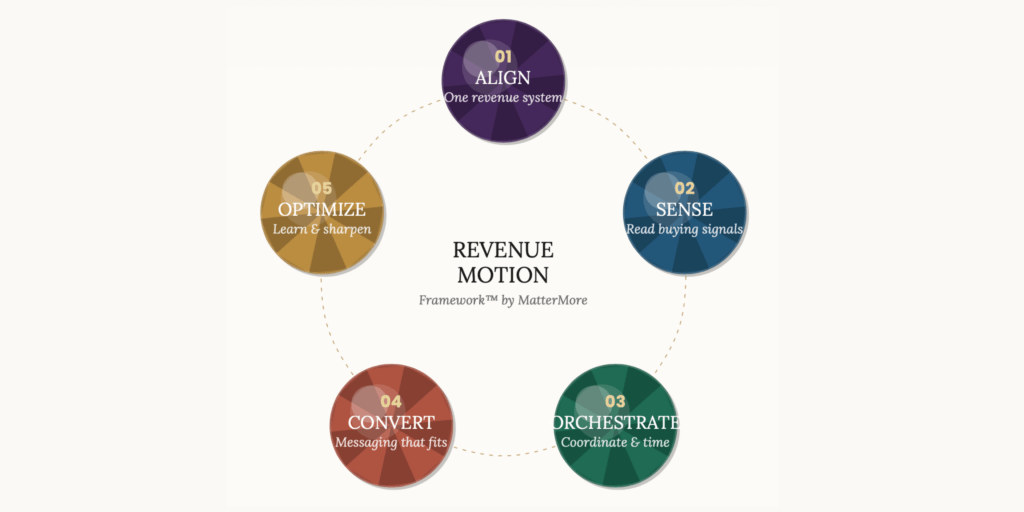
You now have the diagnosis (Why most demand generation fails) and the underlying buyer reality (this post). The next question is the structural one: what does an operating system for B2B demand generation look like once you accept those two truths?
→ Read next: Introducing the Revenue Motion Framework™
→ See the full system: The Revenue Motion Framework™
→ Buy the ebook: Revenue Motion Framework ™ Ebook (€79 ex VAT)
→ Implement it — Toolkit (€149 ex VAT)
FAQ
The dark funnel is the part of the buying journey that happens invisibly to the seller — peer conversations, anonymous research, AI search, internal evaluations, and shortlist building that all occur before any form is filled in. In enterprise B2B, the dark funnel is now the majority of the journey.
Because deals involve buying groups of 10–20+ stakeholders, not individuals. A single lead represents one person at one moment. It does not tell you whether a real buying process is underway across the account. Signal patterns at the account level do.
A buying signal is a pattern of behaviour across an account that suggests a real buying process is happening. Examples include third-party intent spikes, multi-stakeholder site engagement, theme repetition across content, and cross-channel coverage of the same account.
No, but they are demoted. Leads still matter as one input into a signal system, not as the unit of demand on which the entire system reports. The shift is from lead-as-currency to signal-as-currency.