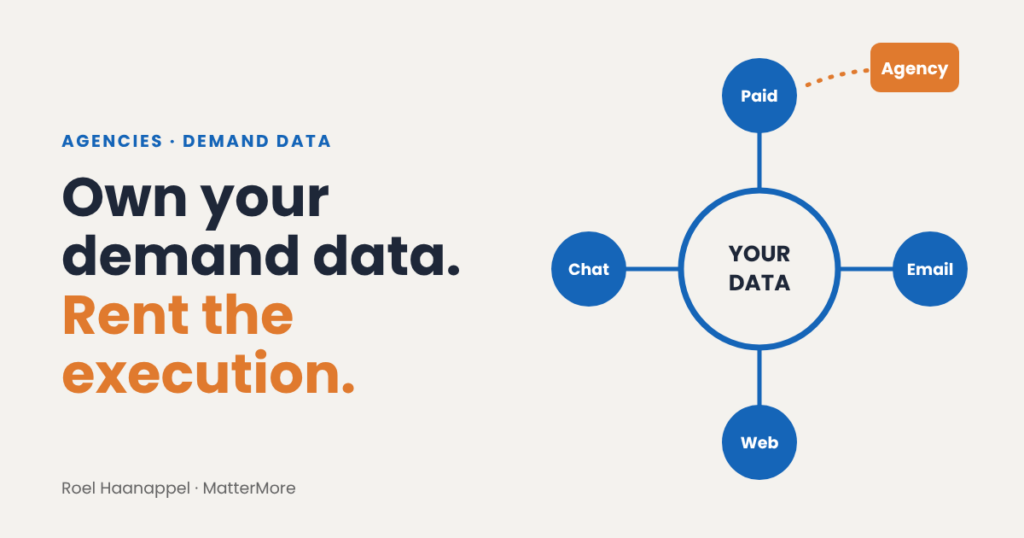
Own your demand data, rent the execution
Most B2B marketing teams outsource part of their demand generation: paid media, content syndication, events. That is often the right call. What goes with it, usually unnoticed, is the data.
Every euro of digital spend generates engagement, whether or not anyone clicks. That engagement is valuable input for everything else you do: email, website personalisation, web chat and account scoring. When it lives in an agency’s accounts and reports, it powers their monthly slide deck. When it lives in your own systems, it powers your demand engine.
Every impression is a signal, not just a click
A campaign report counts clicks, leads and cost per lead. But the real value of paid media in enterprise B2B sits in what happens around the click. Several people from the same account engage with your ads. Their Account Interest Rating goes up. That account can now receive a different email, a personalised web page and a better-informed chat conversation. Sales sees it heating up as context, weeks before anyone fills in a form.
None of that is possible if the engagement data never reaches your CRM.
What to keep in-house, and what to outsource
| Keep in-house | Outsource with confidence |
|---|---|
|
Paid media accounts, pixels and audiences, owned by you |
Campaign management, bidding and creative testing |
|
CRM and marketing automation as the single source of truth |
Set-up and technical implementation |
|
Account-level engagement, intent data and scoring |
Data tooling and integrations |
|
Audience definitions and dynamic audiences |
Building and refreshing the audiences |
|
Landing pages on your own domain |
Design and build of those pages |
|
The definition of what counts as an opportunity |
Nothing: this one is yours |
|
Reporting definitions, based on your own data |
Building the dashboards |
The rule of thumb: own the data and the decisions, rent the execution.
Three places where demand data quietly leaks out
- Paid media in the agency’s accounts. When campaigns run in accounts the agency owns, the audience history, pixel data and learnings leave with the agency. Run everything in your own ad accounts and give the agency access. Good agencies prefer this too: they want the data to show how much impact their work had.
- Content syndication without a nurture. Syndicated leads are generated outside your systems and arrive cold. Without an email nurture that brings them into your own scoring, they stay a list. With one, their engagement becomes a signal, and the right accounts surface for sales.
- Event pages on someone else’s platform. When registrations and page visits sit on an event platform or partner site, you lose the behaviour around the event. Run event landing pages on your own domain whenever you can, so every visit adds to the account’s picture.
What owned data makes possible: always-on personalisation
Once engagement flows into your own systems, you can personalise continuously instead of campaign by campaign. Accounts that warm up move automatically into dynamic audiences. They see different ads, a different web page and different emails, matched to the topics they engage with and their maturity level. No new briefing is needed: the data steers the content.
At Unit4, MatterMore founder Roel Haanappel was leading the team that built its own customer data platform, at a time when that was still new, and put the data to active use. It became the foundation for always-on ABM campaigns with dynamic target audiences, and for the Dynamic ABM programme that won the Forrester EMEA ABM Award.
Later, at SUSE, when Roel was responsible for paid media, the team built a global audience structure on 6sense and ran paid campaigns for every go-to-market motion worldwide from it. Those audiences became the standard for all marketing activities globally, not just paid media, including the global email nurtures. The agencies worked inside SUSE’s own paid media accounts, so every campaign’s engagement fed back into the same account picture, and the agencies could show the impact of their work from the same data.
Why this matters more in the AI era
Buyers increasingly research inside AI assistants instead of on vendor websites. Clicks drop, and first-party signals get thinner. The engagement your own media generates is one of the few signals left that you fully control. Handing it to a third party is a bigger loss than it used to be.
How to start
- Check ownership. List your ad accounts, pixels, audiences, landing pages and CRM fields. For each, ask: who owns it, and what happens to it when we change agencies?
- Connect every outsourced channel to your CRM. Paid engagement feeds account scoring; syndicated leads enter a nurture; event registrations land on your own domain.
- Report on your own data. Ask agencies to report from your systems, on account-level impact and pipeline, not only on their channel metrics.
The agency runs the campaign. You keep the memory.
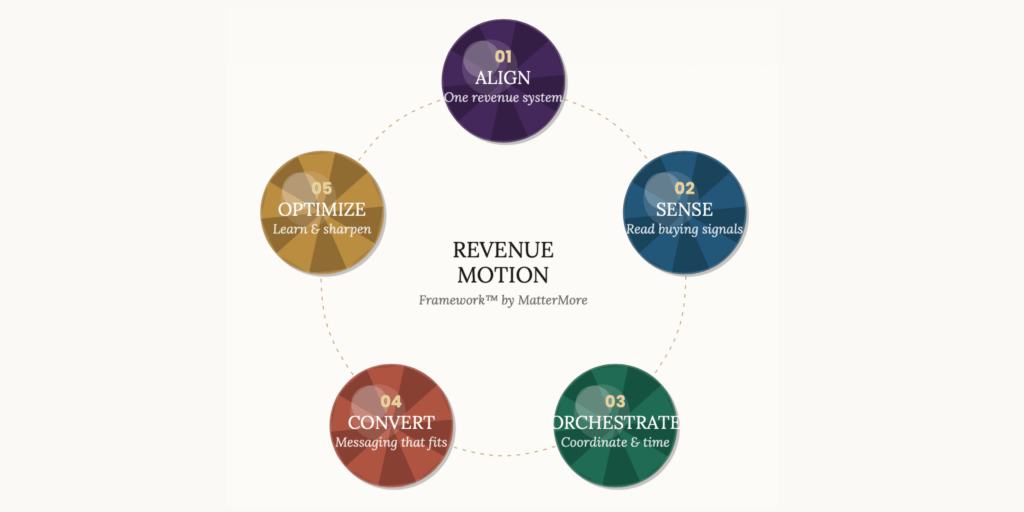
How signals turn into opportunities is described in Phase 2 (Sense) of the Revenue Motion Framework™. Read Phase 2 → · Download the free ebook →
FAQ
Yes. Run campaigns in ad accounts, pixels and audiences that your company owns, and give the agency access. The audience history and engagement data then stay with you when you change agencies, and the agency can still show the impact of its work.
Syndicated leads arrive cold and outside your own systems. Bring them into an email nurture that feeds your own scoring. Their engagement then becomes a signal at account level, and the accounts that show real interest surface for sales.
Audiences that update automatically based on account engagement and intent data in your own systems. Accounts that warm up move into a different audience and see different ads, emails and web content, without a new campaign briefing.
Buyers research more inside AI assistants, so clicks and website signals get thinner. The engagement your own media generates is one of the few signals you still fully control.