Why Most B2B Demand Generation Fails
Most B2B demand generation does not fail because of bad tools, weak campaigns, or under-resourced teams. It fails because marketing operates from the wrong position — not equal to sales, not leading the conversation, but reacting to it. Sales asks for leads. Marketing delivers campaigns. Sales wants pipeline. Marketing reports on MQLs. Everything looks productive, and very little of it drives actual deals.
The pattern is always the same
Sales is focused on hitting short-term targets. Marketing stays busy with campaigns, events, content calendars, and internal updates. On paper, both teams are working hard. In practice, marketing has slowly become a sales service desk — feeding activity, not building demand.
The trigger is usually pressure. When pipeline is missing, sales asks for more. Marketing responds with more campaigns. More leads. Lower quality. More short-term focus. Almost invisibly, the function loses its strategic seat. By the time anyone notices, the role of marketing has been redefined as “the team that fills in for what sales is missing.”
Enterprise B2B doesn't work like that
In most enterprise environments, deals involve 10, 20, or more stakeholders — IT, finance, procurement, the line of business, security, legal. A single lead is not a buying signal. It is noise. The deals that actually close are built across multiple touchpoints, involving multiple people, over months — not from a single MQL on a list.
The clearest way to test this in your own pipeline is to ask one question:
> “How many of last quarter’s deals actually started from a single inbound lead — and how many stakeholders were involved by the time they closed?”
For most enterprise teams, the answer is confronting. Almost no deals come from single lead conversions. Real opportunities are built over time. Marketing was not building demand. It was feeding activity.
The real problem: marketing is not sales-fluent enough
Not in theory. In practice. To break the cycle, marketing needs to become fluent in how revenue actually happens:Understand how deals progress, not just how leads convert.
- Recognise buying-group dynamics — who is involved, what they each need, how their priorities differ.
- Speak the language of pipeline, not clicks.
- Anticipate how buyers actually behave, not how we wish they would.
Until that fluency is there, marketing will keep producing reports that say “the campaign worked” while sales privately disagrees — and the gap between the two stories is the structural reason demand generation feels broken.
The shift that changes everything
High-performing B2B organisations do one thing differently: marketing does not support sales.
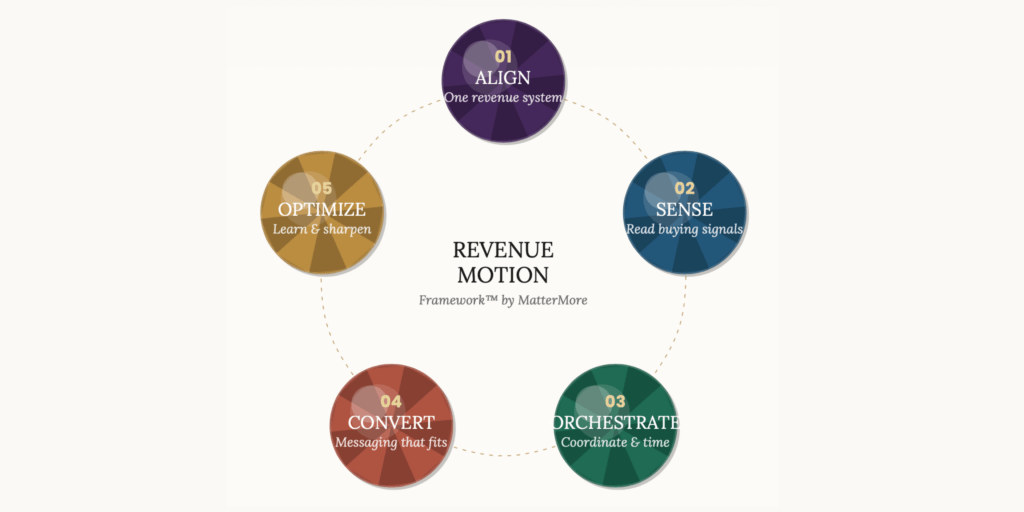
Marketing and sales operate as one revenue system.
That phrase looks soft, but its operational implications are concrete:
- Marketing understands how deals are actually built and is in the conversations where that happens.
- Sales trusts marketing’s signals because marketing is reading them with sales context.
- Both teams work from the same view of audience, timing, and intent.
- There is a shared focus on what drives real impact — not on the metric that flatters each function separately.
This is not a cultural fix. It is a structural one. It starts with shared accountability for the same number — qualified pipeline generated from target accounts — and the operating cadence that makes that accountability real.
What this looks like in practice
At Unit4, applying exactly this principle drove a 10% increase in conversion rates across target accounts and the EMEA Forrester ABM award. The campaigns did not become more sophisticated. The system behind them finally had two functions pulling in the same direction.
That single change — replacing parallel accountability with shared accountability — is what unlocks every other improvement. Without it, more tooling, more signal data, more AI, and more content all amplify the existing dysfunction at higher cost.
Where to go from here
If this describes your team, the next thing to understand is *why* enterprise buying behaves the way it does — because the buying-group reality is what makes the lead model fail in the first place.
→ Read next: How Enterprise buying Actually Works
→ See the full system: The Revenue Motion Framework™
→ Buy the ebook: Revenue Motion Framework ™ Ebook (€79 ex VAT)
→ Implement it — Toolkit (€149 ex VAT)
FAQ
Because marketing and sales are accountable for fundamentally different metrics — marketing for MQLs and campaigns, sales for revenue. In the gap between those metrics, real buying opportunities go unworked. The fix is shared accountability for qualified pipeline from target accounts, not better campaigns.
No. In enterprise B2B, deals involve buying groups of 10–20+ stakeholders. A single lead is noise. Volume of leads tells you almost nothing about whether real buying processes are happening.
It is the same problem. ABM is one expression of the buying-group reality. Demand generation as a whole has to evolve to fit how enterprise buying actually works — ABM is part of that evolution, not separate from it.
Replace separate marketing and sales metrics with a single shared pipeline target from agreed target accounts. Everything else — joint account selection, common pipeline language, integrated planning — follows from that one structural change.