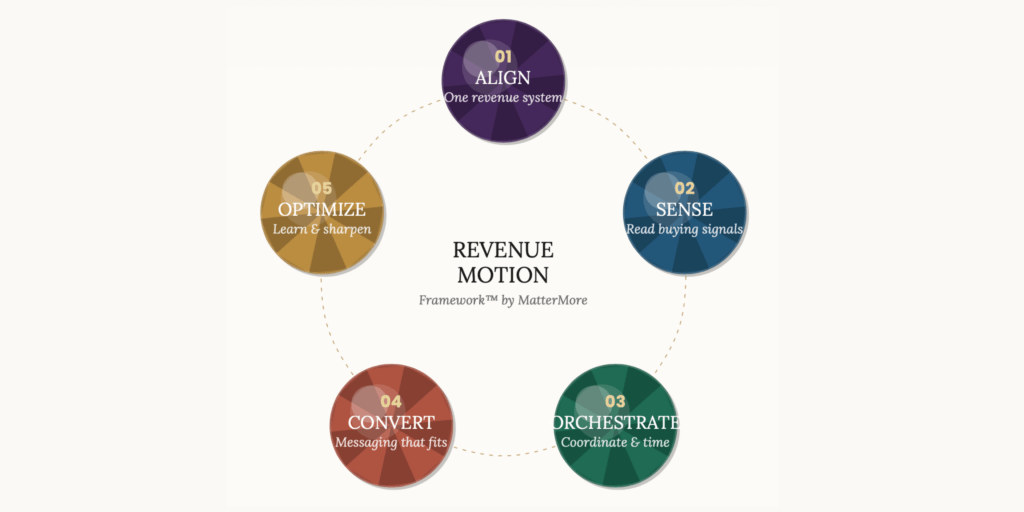
Introducing the Revenue Motion Framework™
The Revenue Motion Framework™ is a five-phase operating system for enterprise B2B demand generation, developed by Roel Haanappel and used at MatterMore. Its phases are Align, Sense, Orchestrate, Convert, and Optimize. They run as a continuous motion rather than a funnel — each phase feeds the next, and the last phase feeds back into the first. The framework replaces lead-volume thinking with signal-based, account-centric, marketing-and-sales-shared revenue operations.
Why a new framework is needed
Most B2B demand generation programs are not broken because of bad people or bad tools. They are broken because they are built on the wrong model.
Marketing runs campaigns. Sales chases leads. Both report to leadership separately. And somewhere in the gap between the two functions, real buying opportunities get missed — often without anyone noticing.
What enterprise revenue actually requires is something different. Not a campaign. Not a funnel. A motion.
A motion, not a funnel
The word “motion” is deliberate. A model describes how something looks. A motion describes how something moves.
Enterprise buying is always in motion — accounts heating up and cooling down, stakeholders entering and leaving the process, priorities shifting mid-quarter. A static model cannot keep up with that reality. The Revenue Motion Framework™ is designed to move with it. That is what makes demand generation predictable: not control over the buyer, but a system that genuinely understands how buying actually works.
The five phases
The framework has five phases that work together as a continuous cycle. Each phase feeds the next; the last feeds back into the first.
01 — Align. Before anything else works, marketing and sales must operate as one revenue system. Not as separate functions with separate targets. This means shared definitions of who you are going after, shared language around pipeline, and shared accountability for what actually matters — deals moving forward.
02 — Sense. Once aligned, the system needs to read what is actually happening in the market. Not by counting leads — but by sensing buying-group signals across target accounts. Which companies are showing intent? Which stakeholders are engaging? What topics are gaining traction?
03 — Orchestrate. Signals alone do not drive revenue. Orchestration does. This phase is about coordinating marketing and sales actions across the right accounts, the right people, and the right moments — based on what the signals are telling you.
04 — Convert. Orchestration creates the conditions. Messaging converts them. This phase is about building a messaging *system* — not a single campaign — that speaks to every stakeholder in the buying group based on their role, their concerns, and where they are in the decision process.
05 — Optimize. This is where most frameworks stop. The Revenue Motion Framework™ does not. The Optimize phase closes the loop — using real feedback from sales, pipeline data, and signal patterns to continuously sharpen every phase above it.
Why each phase only works in order
Each phase depends on the one before it being in place.
- Sense without Align produces a flood of signal data that no one can act on coherently — marketing and sales each interpret the signals in their own context.
- Orchestrate without Sense is back to campaign calendars and territory plans — coordinated action without a real read on which accounts are actually moving.
- Convert without Orchestrate is a beautifully written message landing in front of the wrong stakeholder at the wrong moment.
- Optimize without all of the above is dashboarding for its own sake — refining inputs to a system whose foundation is wrong.
This is why the framework is best implemented in order, with each phase given enough time to settle before the next is layered on top.
How the framework changes day-to-day operations
The shift is concrete, not abstract. Once the framework is in place:
- Account selection becomes a joint marketing-and-sales conversation, not a one-sided list handed over.
- Reporting moves from MQL volume to *count of target accounts with rising signal*, *qualified pipeline from target accounts*, and *deal velocity inside known buying groups*.
- Campaigns become orchestrated *plays* triggered by signals – not calendar-driven launches.
- Messaging is built per stakeholder role and decision stage, not per channel.
- Optimisation reviews use sales-deal data and signal data side by side, not in separate tools.
The result is what high-performing teams describe as “demand generation that finally feels like part of the revenue function” — because structurally, that is what it has become.
Where to start
The framework is designed to be implemented in 90 days as a starting motion, then refined for 6–12 months as the system matures. The closing chapter of the ebook lays out the full 90-day roadmap; in summary:
- Days 1–30 — Align + early Sense. Shared targets agreed, joint account list selected, signal infrastructure scoped.
- Days 31–60 — Sense + Orchestrate. Signal feeds live, scoring model in place, first orchestrated plays running on warming accounts.
- Days 61–90 — Convert + Optimize. Messaging system built per stakeholder role, weekly optimisation cadence in place.
Most organisations cannot stand the framework up entirely on internal capacity alone — not because the work is enormous, but because the operating-pattern change is hard to drive from inside an existing org chart. That is the work MatterMore does.
Where to go from here
If you have read the previous two posts in this series, you have the diagnosis and the buyer reality. This post gave you the operating system. The next step is to look at where your own organisation sits within it.
→ Read the methodology in full: The Revenue Motion Framework™
→ Buy the ebook (€79 ex VAT) with the complete five-phase deep-dive and the 90-day roadmap
→ Buy the Implementation Toolkit (€149 ex VAT) for ebook + 90-Day Action Plan + one-pager
→ Talk to MatterMore about implementing it
FAQ
The Revenue Motion Framework™ is a five-phase operating system for enterprise B2B demand generation, developed by Roel Haanappel. Its phases are Align, Sense, Orchestrate, Convert, and Optimize. It replaces the traditional lead funnel with a continuous, signal-driven motion designed around how enterprise buying groups actually move.
The funnel assumes individual buyers moving through linear stages. The Revenue Motion Framework™ assumes buying groups moving through a continuous, non-linear process. It reads signals instead of counting leads, runs marketing and sales as one revenue system, and treats optimisation as a permanent feedback loop rather than a quarterly review.
ABM is part of the Orchestrate phase, but the framework is broader. ABM is a tactic; the Revenue Motion Framework™ is the operating system that makes ABM, intent data, and personalisation work together as one system rather than as parallel programs.
The ebook lays out a 90-day roadmap to stand up an initial motion. Full maturity typically takes 6–12 months, depending on organisational starting point — particularly how much alignment and signal infrastructure already exists.
The framework’s structure is in the public posts and on `/revenue-motion-framework/`. The book provides the deep, phase-by-phase implementation detail and the 90-day roadmap. Most teams that adopt the framework find the book the most efficient way to get every relevant person on the same page quickly.