AI in B2B Demand Generation: Personalisation, Reframed
Most B2B teams talk about AI as if it were a strategy. It isn't. AI is intelligence — the capacity to analyse patterns, predict, and generate. It belongs underneath your operating model, not on top of it. Here's what that changes.
The 'AI personalisation' promise has become noise
There is no shortage of B2B vendors promising AI-powered personalisation. Most of it amounts to the same thing it always did: a templated email with `{FirstName}` interpolated, sent at scale, with a slightly cleverer subject-line generator behind it. The output looks personal. It isn’t.
The fundamental problem is the framing. “We have an AI personalisation strategy” is a sentence that should set off alarm bells. AI is not a strategy. It is not a goal. It is not, on its own, a competitive advantage. AI is intelligence — the capacity to analyse patterns, generate predictions, personalise communication, and adapt models based on outcomes. Useful, often essential, never sufficient.
The teams that actually move pipeline with AI in B2B demand generation aren’t the teams shouting loudest about it. They’re the teams whose AI usage is invisible — embedded in the operating model rather than announced in a deck. They aren’t “doing AI personalisation.” They’re using AI as the intelligence layer underneath the operating model that decides who to talk to, when, with what message, and why.
AI as underlying capability, not as a chapter
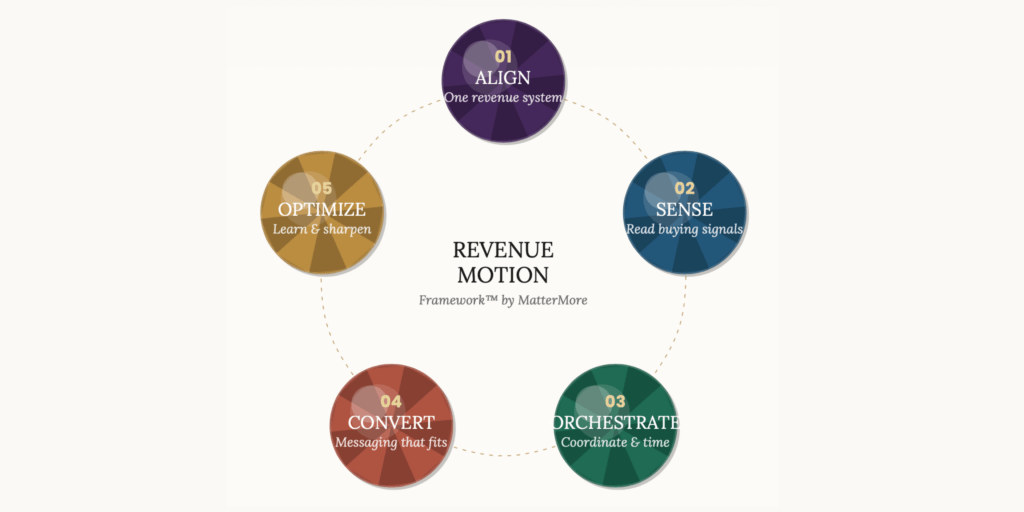
In the Revenue Motion Framework™, AI isn’t a phase. It isn’t a sixth box on the diagram. It runs underneath all five phases — Align, Sense, Orchestrate, Convert, Optimize — making each phase sharper than it could be without intelligence. The principle is consolidation, not accumulation. Integration, not addition.
This matters because the alternative — treating AI as its own initiative — is what produces the dashboards-with-no-decisions outcome you see in most B2B teams. They buy an AI tool, run a campaign, generate a quarterly report on “AI-driven personalisation,” and pipeline stays flat. The AI worked. The operating model didn’t.
The honest question, before any AI investment, isn’t “how should we use AI?” It’s: where in our current operating model does intelligence make the biggest difference? That answer is different for every team. The framework gives you a clean way to look.
Where AI actually fits in each of the five phases
Phase 1 — Align.
AI helps you find the accounts that look like your best customers but aren’t yet on your radar — clustering by firmographic, behavioural, and intent patterns to refine your ICP definition (see Phase 1 — Align). The contribution is bounded: AI proposes; the joint marketing-sales decision still owns the list. AI doesn’t replace the structural shift to shared accountability for pipeline — but it makes the conversation more data-grounded.
Phase 2 — Sense.
This is where AI does the heaviest lifting in B2B demand generation, and where the ROI is most defensible. The signal-scoring model that produces the Account Interest Rating (AIR) is fundamentally an AI application: weighting signals by predictive value, decaying them over time, correlating multi-role engagement across an account, learning from won-deal histories. The teams getting genuine traction from intent data aren’t the ones buying more data — they’re the ones whose AI is correctly valuing the data they already have. See Phase 2 — Sense for the full operating model. If you only invest in AI in one phase, this is the one.
Phase 3 — Orchestrate.
AI supports the Marketing Account Developer’s queue work in two ways: by recommending which play to run against a recognised spike pattern, and by generating per-role messaging variants drawn from the matrix. AI also alerts the team when an account’s pattern matches a known win-precursor — useful intelligence, but only if the human has the time and discipline to act on it (see Phase 3 — Orchestrate).
Phase 4 — Convert.
Here AI’s contribution is more subtle and arguably more valuable. The persona × maturity messaging matrix (see Phase 4 — Convert) is impossible to maintain at scale without AI — it requires inferring buyer maturity (A through E) from engagement signals across multiple touchpoints, then surfacing the right matrix cell to the AM in real time. AI also generates the per-cell messaging variants. This is what genuine “personalisation” looks like in an enterprise B2B context: not “Hi {FirstName}, I noticed you visited our pricing page,” but the right angle for the right role at the right maturity level via the right channel at the right moment. That is a system, not a campaign.
Phase 5 — Optimize.
AI surfaces cross-phase patterns the human eye misses — “win-rate is dropping specifically on accounts where the MAD didn’t include the CFO touch on Day 4 across two industries and three quarters.” Human leaders still own the weekly operating meeting and the button-moves it produces. AI provides the pattern recognition that makes those decisions sharper (see Phase 5 – Optimize).
What 'personalisation' actually means in this model
Stop thinking of personalisation as a campaign output. Start thinking of it as an emergent property of an operating model that is finely tuned.
In the framework, “personalised” doesn’t mean customised at the surface. It means: this CFO got a procurement-fit message because Phase 2 detected three roles from her buying group engaging with pricing pages, Phase 3 triggered a Pricing + Competitor Comparison development play, Phase 4 placed her at maturity level C from her language and engagement pattern, and the messaging matrix surfaced the Procurement-at-C cell for that conversation. The CFO experiences one coherent, relevant message. Behind it sits an operating model running on intelligence.
This is genuinely difficult to achieve and impossible to fake. It’s also why the “AI personalisation” promise from most vendors falls flat — they sell you the surface (the email subject line) without the operating model underneath. Without the operating model, the email is just templated automation in a more flattering wrapper.
Where to start with AI in B2B demand generation
Three pieces of practical advice if you’re trying to make AI actually move pipeline rather than just look impressive in a board update:
- Don’t start with the most visible use case (personalised emails). Start with the highest-leverage one — account-level signal scoring.
The AIR model in Phase 2 — Sense is where AI produces the largest, fastest, most defensible ROI in B2B demand generation. Get this right first, before anything else. - Build AI into the operating model, not alongside it.
If your AI tool requires its own weekly meeting, its own dashboard, its own dedicated owner separate from the marketing-sales operating cadence — you’ve added AI to your stack rather than integrated it. That model rarely compounds. - Measure AI’s impact at the system level, not the feature level.
Not “the AI subject-line generator increased open rates by 8%.” Instead: “win rate on Accepted Opportunities developed with AI-scored signals ran above win rate on cold-outbound.” If you can’t measure AI at the system level, you don’t have a system — you have a feature.
The teams that win on AI in B2B demand generation are the ones whose AI usage is invisible — woven into a framework that runs deliberately rather than tacked onto one that doesn’t.
Three ways to take this further:
- Read the full framework — the Revenue Motion Framework™ ebook covers all five phases, including how AI fits underneath each one. Buy the ebook (€79 ex VAT) →
- Implement it — the Implementation Toolkit adds the 90-Day Action Plan deck for putting the framework into practice. Get the Toolkit (€149 ex VAT) →
- Work through your operating model together — book a Strategic Review and we’ll audit where AI is currently sitting in your demand generation stack, and where it would compound. Request a Strategic Review →
FAQ
No. Sending better emails is the most visible AI use case in B2B but rarely the highest-impact one. The biggest ROI from AI in B2B demand generation usually sits in account-level signal scoring (Phase 2) and the messaging matrix population (Phase 4) — neither of which is visible to the buyer as “personalisation” in the marketing-automation sense, but both of which materially shift what closes.
Segmentation puts buyers into bigger or smaller buckets. AI-driven personalisation (done properly) detects each buyer’s specific maturity level, role-specific concerns, and current decision context — then matches the right messaging matrix cell to that pattern in real time. Segmentation is static; AI-driven personalisation is dynamic. The difference shows up in deal velocity and win rate, not in subject-line A/B tests.
Account-level signal scoring (Phase 2 — Sense). Highest ROI, fastest to prove, most defensible against scepticism, and produces an output (the Account Interest Rating) that both marketing and sales can act on immediately. Resist the temptation to start with the visible use cases.
Not necessarily. The principles in the framework can be operationalised with the AI capabilities already inside your CRM, intent data platform, and marketing automation stack. The question to ask before any new AI purchase: which phase of the operating model is this tool sharpening, and is that phase already running well enough that the AI investment is worthwhile? Buying AI capability for a phase that hasn’t been built yet rarely produces results.
At the system level: Spotted → Qualified conversion rate, Qualified → Accepted approval rate, win rate on Accepted opportunities, deal velocity. AI is working when these numbers move. If feature-level metrics (open rate, click-through, model accuracy) improve but system-level metrics don’t, the AI is decorating the operating model rather than improving it.